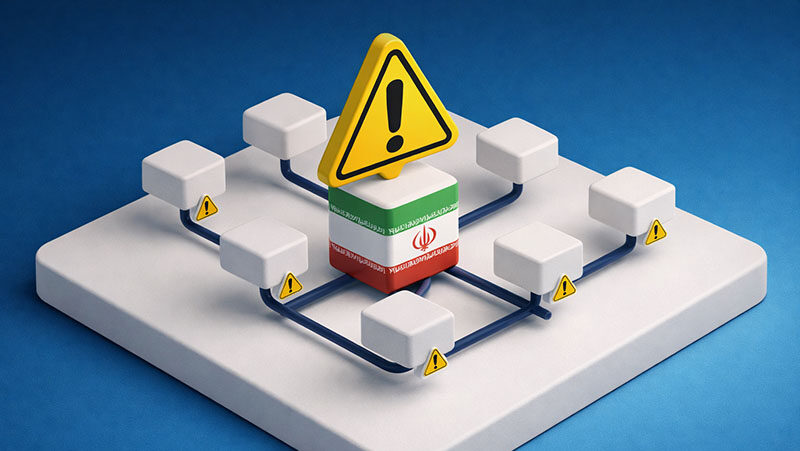
The European Union has formally added the Iranian Revolutionary Guard Corps (IRGC) to the European terrorist list. This decision follows the bloody suppression of protests in Iran, which according to various sources left thousands dead. This step is mainly symbolic in nature, but the consequences are real. There is an entry ban, assets are frozen, and it is prohibited to do business with entities affiliated with the IRG.
Although trade between EU countries and Iran has already declined dramatically in recent years, the risk of indirect exposure remains. Companies operating in international chains need to be extra vigilant. Where in the chain might there be IRG-affiliated companies? After all, the EU has confirmed that the IRG is deeply embedded in the Iranian economy, including in construction, infrastructure, telecommunications, logistics, and the oil industry.
Wasn't there already a strict sanctions regime in place?
Yes, and that is precisely why analysts believe the new measure will have a limited economic impact. Trade between the EU and Iran has been on a downward trend in recent years, partly due to existing sanctions and international pressure surrounding the nuclear program. The figures below show that there is economic interdependence that could pose risks:
- Total EU–Iran trade amounted to approximately €4.5 billion in 2024., of which approximately €0.8 billion were imports and approximately €3.7 billion were exports.
- In 2025, trade fell to approximately €2.8 billion (−18%) in the first nine months.
- Dutch exports to Iran amounted to around €430 million. This makes the Netherlands the second largest EU exporter to Iran.
- Dutch imports from Iran are relatively small. During the same period, Iran had a a trade deficit of around €60 million with the Netherlands.
These figures underscore that the direct economic impact of the new measure is limited, but that there are indeed existing trade relations that may harbour risks.
At the same time, the inclusion of the IRG on the terrorist list is crucial for compliance. It confirms how strictly and broadly European sanctions rules are enforced and how significant the consequences are for companies that do business with the wrong parties.
The IRG had already been sanctioned by the EU due to proliferation and security risks. However, the new classification as a terrorist organization significantly increases the risk of unwitting involvement through indirect corporate structures.
Interesting read: Everything about our compliance solutions
Why this announcement is important for European companies
The IRG is not only a military organization, but also an economic power with a network of entities that is deeply intertwined with the Iranian public and commercial sectors. Among other things, it owns and manages:
• large construction and infrastructure companies,
• assets in oil exploitation and logistics,
• interests in energy, telecommunications, and various industrial sectors.
This means that an apparently legitimate Iranian company, or even a non-Iranian supplier or customer, may have hidden ties to this sanctioned entity.
Even if your organization does not do business directly with Iran, supply chain exposure remains a real risk. Consider multinational suppliers, subsidiaries, financial flows, or partners that may be indirectly affiliated with IRG entities.
This development is therefore not something that is “far removed from our daily lives,” but rather a concrete reason for EU companies to review their compliance.
What does this mean for your existing order portfolio?
The main implication is clear:
Every organization must re-examine its existing business relationships, suppliers, customers, investments, and partners.
Why?
- IRG-affiliated companies often operate under different names, through subsidiaries or complex ownership structures.
- EU sanctions Now affect not only individual officials and known IRG entities, but also parties that have material ownership or control by the IRG.
- A violation, even if unintentional, can result in legal, financial, and reputational damage.
In addition to its symbolic value, the measure also aims to limit the IRG's financial power. This means that financial transactions, supply chains, and ownership structures will be monitored more closely.
How Altares Dun & Bradstreet helps organizations in this new reality
The value of high-quality business information becomes particularly apparent when sanctions are imposed on entities with complex business networks. Altares Dun & Bradstreet offers:
1. Global, in-depth business structures
With access to the world's largest commercial database, containing more than 620 million company profiles, we identify parent, subsidiary, and sister relationships, even when these are hidden within international structures.
Interesting read: Understanding complex UBO structures
2. Direct screening and real-time monitoring
Our compliance solutions enable you to:
- screen suppliers and customers against sanctions lists and PEP statuses,
- receive risk signals in the event of changes in corporate structures or UBO relationships,
- receive automatic alerts when entities are added to international sanctions lists.
3. Waterproof audit trail for Wwft and sanctions regulations
All screenings, decisions, and due diligence steps are automatically recorded. This is essential in light of increasing regulatory pressure.
4. Proactive risk identification with third parties
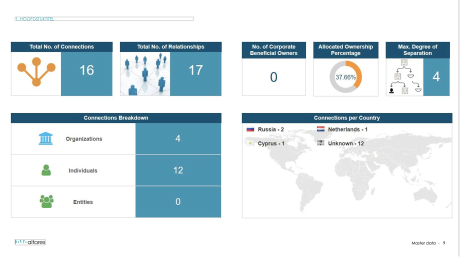
Our IndueD solution offers in-depth UBO analysis, visualization of corporate networks, and continuous risk monitoring. This is crucial now that sanctions regimes are changing rapidly and entities can appear on lists overnight.
Interesting read: All about indueD
Conclusion: now is the time to reassess your supply chain
The inclusion of the Iranian Revolutionary Guard Corps (IRGC) on the EU terrorist list is more than a symbolic gesture. It underscores the importance of:
- thorough due diligence,
- current sanctions screening,
- insight into (pseudo-)UBO structures,
- continuous monitoring of international business relationships.
Organizations that do not have their compliance processes in order are facing greater risks than ever before. Due to the economic interdependence of the IRG, it is virtually impossible to determine whether a counterparty is fully compliant without specialist data.
With Altares Dun & Bradstreet's global data and compliance expertise, you can continue to do business with confidence, within the law, with minimal risk and maximum security.
Would you like to know whether your organization has exposure to sanctioned parties?
Our specialists are happy to help you.