Europe is on the eve of the biggest anti-money laundering reform to date. With the arrival of the European Anti-Money Laundering Authority (AMLA), not only will the way supervision is organized change, but also what is expected of reporting institutions. The impact of this is clearly confirmed in the publication The Future of Anti-Money Laundering in the European Union by the European Parliament's Economic Governance and EMU Scrutiny Unit. That briefing analyzed the establishment of the European Anti-Money Laundering Authority (AMLA) within the 2024 AML/CFT framework and its implications for reporting institutions in the European Union.

Why AMLA is important
Money laundering and terrorist financing are real risks. According to the UNODC, up to 5 percent of global GDP is laundered annually. Within the EU, 70 percent of criminal networks rely on money laundering to conceal illegal proceeds. Scandals such as those involving Danske Bank, Swedbank, and Pilatus Bank show how fragmented supervision can undermine confidence in the financial system.
But the problem is far from over. Between March 2024 and March 2025, European regulators imposed more than €36 million in fines in approximately 30 enforcement cases, mainly targeting payment service providers (PSPs) and electronic money institutions (EMIs). These cases revealed structural deficiencies in customer due diligence, governance, and transaction monitoring.
Europol's SOCTA 2025 report also warned that criminal networks are increasingly using cryptocurrencies and decentralized finance (DeFi), creating parallel financial systems that threaten economic stability. Meanwhile, Nasdaq Verafin estimated that around $750 billion in illicit funds flowed through Europe in 2024, with a quarter of that amount crossing borders.
These scandals and reports underscore why the creation of AMLA is so crucial. Fragmented oversight is no longer a viable option in a financial system that is digital, borderless, and vulnerable to abuse.
Interesting read: Preparing for the AMLA: Four steps to a watertight AML framework
Challenges for regulators and reporting institutions
The new framework introduces uniform obligations under the Anti-Money Laundering Regulation (AMLR), institutional coordination through the sixth Anti-Money Laundering Directive (AMLD6), and centralized supervision by AMLA. For reporting institutions, this means:
- Stricter customer due diligence: customer verification, transparency of ultimate beneficial owners, and additional checks for high-risk transactions.
- Limits on cash payments: an EU-wide upper limit of €10,000 to reduce anonymity.
- Supervision of digital finance: crypto service providers (CASP) and DeFi platforms now clearly fall within the scope.
- Cross-border information exchange: national Financial Intelligence Units (FIUs) must cooperate more closely, supported by AMLA.
Sector-specific impact
The reforms affect various reporting parties in different ways:
- Banks and insurers: already heavily regulated, but now bound by harmonized EU standards that reduce national differences.
- Payment service providers and fintechs: subject to stricter supervision following recent fines, they must carefully balance innovation and compliance to ensure that instant payments and open banking do not open the door to illegal money flows.
- Cryptographic service providers (CASPs): newly designated as reportable under AMLR, with stricter requirements for customer due diligence and monitoring.
- Non-financial reporting entities: brokers, accountants, lawyers, and even soccer clubs must adapt to obligations that may feel new but are essential to closing loopholes.
Global context
The EU reform does not stand alone. It is in line with international standards set by the Financial Action Task Force (FATF), which has long promoted transparency in financial transactions. By embedding AMLA in EU governance, the EU is positioning itself as a global leader in financial integrity.
What now: the road to 2028
The introduction of AMLA will take place in phases:
- 2028: AMLA becomes fully operational with direct supervisory powers over high-risk institutions.
- 2025: AMLA commences operations in Frankfurt.
- 2027: Member States must implement AMLD6 into national law.
Checklist for institutions subject to reporting requirements
Institutions subject to reporting requirements can prepare as follows:
- Identify which parts of AMLR and AMLD6 apply to your organization.
- Ensure that customer data and data on UBOs are complete and up to date.
- Automate compliance processes to make reporting and monitoring scalable.
- Invest in training for teams in compliance, risk, and operations.
- Actively follow the guidance of AMLA and national supervisory authorities.
The role of reliable data in AML compliance
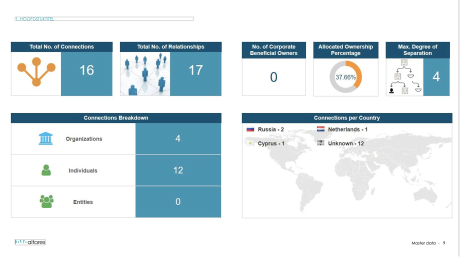
At Altares Dun & Bradstreet, we view compliance as a strategic issue. We support organizations with reliable data, analyses, and insights to meet expectations in this new regulatory landscape. Our global corporate structure data provides insight into ultimate beneficial owners. Risk scores and monitoring tools are aligned with the harmonized risk approach within the EU. Thanks to the Dun & Bradstreet Data Cloud, organizations gain better visibility into cross-border relationships and transactions. Automated workflows also reduce the operational burden and create room for strategic growth. View our compliance solutions here.
Interesting read: What data do you need for an effective compliance process?
Compliance as an advantage
AML/CFT reform is not just about avoiding fines. It helps organizations build trust in a market where transparency is increasingly valued. Those who embrace the changes in a timely manner and work with reliable data and technology will not only comply with the rules but also strengthen their reputation and resilience.