Part 1 of 6 in our series on compliance lessons from the FIU 2025 Annual Report.
Three million unusual transactions. More than 92,000 of these were declared suspicious in 2025. The FIU 2025 Annual Report is more than a collection of figures. Above all, it shows how financial crime is organised.
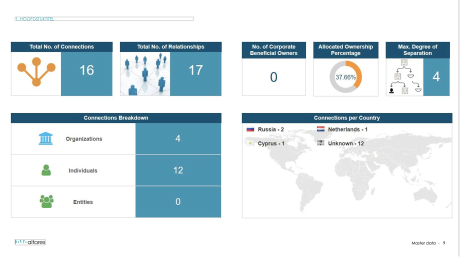
And increasingly, this does not revolve around one person, one company or one transaction. Criminals operate through networks of businesses, intermediaries and financial flows. This is an important observation for compliance. When risk is spread across multiple parties, checking only the direct customer is not enough. In this blog, we look at what this means for KYB, business identification and monitoring.

What is FIU-the Netherlands?
FIU-the Netherlands analyses reports of unusual transactions from banks, notaries, accountants and other entities subject to the Dutch Anti-Money Laundering and Anti-Terrorist Financing Act (Wwft). Transactions that are deemed suspicious following analysis are made available to law enforcement and security services.
The annual report therefore provides valuable insight into the patterns behind money laundering, fraud and sanctions evasion. These patterns are particularly relevant. They show that financial crime often only becomes visible when you look beyond a single transaction or company.
Financial crime operates as an ecosystem
FIU-the Netherlands describes increasingly professional criminal networks in which different parties fulfil different roles. One may provide front men, another may set up companies, while others facilitate payments or ensure that ownership remains hidden.
This makes compliance checks more complex. A company may appear legitimate on paper, while the structure around it tells a very different story. Think of intermediaries, affiliated companies, complex ownership chains or UBOs who are not immediately visible. Front companies and international structures also play an important role in sanctions evasion.
For compliance, this means you cannot stop at asking whether a company name passes a screening check. You need to know exactly which legal entity you are doing business with, who is behind it and which other parties are connected to it.
Interesting read: Why “quickly checking” compliance is never sufficient
Without the right business identity, there is no reliable risk picture
Precisely because risks can spread across multiple organisations and individuals, you need to be certain that you are looking at the right company. Trade names may differ from legal names, and international corporate groups often consist of multiple entities. If information is linked to the wrong organisation, the resulting risk picture can also be incorrect.
Reliable business identification is therefore an important foundation for KYB. Dun & Bradstreet uses the D-U-N-S® Number, to uniquely identify organisations worldwide, ensuring that information about ownership, UBOs, corporate structures and compliance risks can be linked to the correct entity. This allows you to look beyond whether a party appears on a risk list and understand who is behind it and which relationships influence the overall risk picture.
Monitoring does not stop after onboarding
An organisation’s risk profile does not stand still. Directors change, ownership structures evolve and new business relationships can emerge. Something that did not warrant further investigation during onboarding may therefore become relevant later.
This is why continuous monitoring is so important. Not to treat every change as a risk, but to identify changes in time and reassess them when necessary. Especially when financial crime develops through networks, a one-off check is simply not enough.
Interesting read: Perpetual KYC: why customer due diligence does not stop after onboarding
What does this mean for compliance?
The FIU-the Netherlands 2025 Annual Report shows above all that financial crime is interconnected. This calls for a compliance approach that looks beyond the direct customer and also provides insight into the legal entity, ownership structure, business relationships and relevant changes throughout the customer relationship. Not more checks, but better context. Because if you only look at one party, you may see only part of the actual risk.
Can you see what is happening behind your customer? Discover how reliable business data can help make hidden relationships and risks visible earlier with our compliance experts.