The Dutch real estate market is showing signs of recovery. According to the Real Estate Market Outlook Report 2026 of CBRE Netherlands in 2025, the total investment volume in commercial real estate amounted to €13 billion, an increase of 15% compared to 2024. Residential properties, offices, and logistics in particular contributed to this growth.
However, an increase in transactions also brings new challenges for tenant risk management. Rental income often forms the core of returns, while commercial leases typically run for five to ten years. During this period, tenants’ financial situations can change significantly, affecting the stability of income. In this context, it is becoming increasingly important for real estate professionals not only to assess the current financial situation of tenants but also to plan ahead.

Key Insights for Data-Driven Tenant Analysis
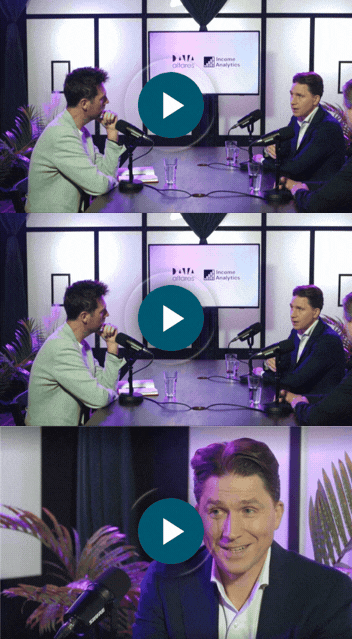
During the recent webinar by Altares Dun & Bradstreet and Income Analytics highlighted three insights that help real estate professionals better assess tenant risks:
- Tenant risk should be assessed proactively.
Traditional credit scores primarily provide a snapshot in time. By combining historical company data, industry trends, and risk models, a clearer picture emerges of how a tenant’s risk profile evolves over the duration of the lease. - Portfolio exposure is often underestimated
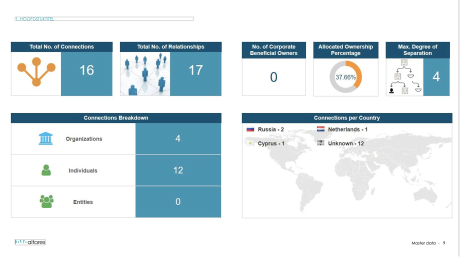
In large real estate portfolios, multiple tenants may belong to the same corporate group or sector. By analyzing corporate structures and risks at the portfolio level, hidden concentration risks can be identified. - Continuous monitoring becomes essential
Companies are constantly changing due to mergers, reorganizations, or financial developments. Real-time monitoring of Dun & Bradstreet data enables real estate professionals to quickly detect when a tenant’s risk profile changes.
As Michiel Foekens, Sales Director at Income Analytics, it summarizes:
"For real estate investors, it is ultimately not just about the value of the building, but about the stability of the rental income that the building generates."
From Insights to Practical Application
These insights demonstrate how real estate professionals can manage tenant risk throughout the duration of a lease. To make this possible in a reliable and continuous way, Altares Dun & Bradstreet and Income Analytics combine their expertise. By integrating global company information with real estate data, investment managers can not only assess risks at the time of acquisition but also monitor them throughout the entire lease term. This generates concrete risk insights, enabling professionals to make better-informed decisions.
Data as the Foundation for Stable Rental Income
As the real estate market rebounds, the importance of data-driven decision-making is increasing. By combining real estate data with global company information, investment managers gain better insight into tenant quality, portfolio exposure, and long-term risk. For organizations active in commercial real estate, this represents a shift from reactive risk management to proactive monitoring of tenants and their business risks.
Be sure to watch the webinar: Webinar: How secure is your real estate investment?