AI makes it possible to analyse large volumes of real estate information in a short amount of time. Lease agreements can be processed automatically, tenant data can be structured, and key contract terms can be retrieved much faster. However, accurately analysing a lease agreement does not automatically provide a complete view of risk. For example, a tenant's name alone does not reveal the legal entity behind the business or the corporate group to which it belongs.
This missing business context was the focus of a recent webinar hosted by Income Analytics. Together with experts from The Oakland Group and real estate organisation Indurent, Altares Dun & Bradstreet discussed how AI can accelerate real estate processes and why reliable business data is essential. In this blog, you'll discover how to transform information from lease agreements into trusted insights for better real estate decision-making.

AI makes real estate information accessible
Real estate organisations manage vast amounts of information contained in lease agreements, property valuations, and investment memoranda. AI can analyse these documents and quickly extract information such as tenant names, lease terms, rental amounts, and termination dates. This saves time while making real estate information easier to search, analyse, and use in decision-making.
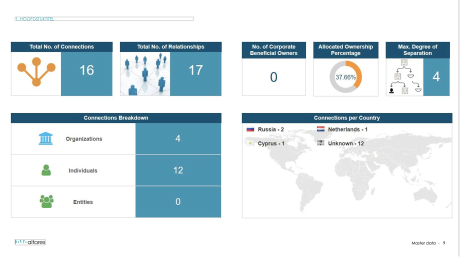
However, an AI model can only work with the information it has access to. While a lease agreement typically contains the tenant's name, it rarely includes the full corporate structure behind that business. As a result, it remains unclear which companies belong to the same corporate group or who the ultimate parent company is.
A real estate portfolio may be less diversified than it appears
During the webinar, a logistics real estate fund with forty lease agreements was presented as an example. On paper, the portfolio appeared well diversified: no individual tenant accounted for more than 6% of rental income. However, after linking the tenants to their ultimate parent companies, a different picture emerged. Fifteen tenants turned out to belong to just four corporate groups, increasing the actual exposure to a single group to almost 20%.
AI can therefore correctly extract tenant names from lease agreements while still missing a significant concentration risk. The relationship between legal entities and their parent companies simply does not exist within the lease agreement itself. That context must be added using reliable business data.
Interesting read: Data-driven tenant analysis becomes crucial as real estate investments pick up
The right legal entity as the starting point
Business names are not always unique or consistent. A company may operate under multiple trading names, consist of several local legal entities, or appear under different spellings across systems and documents. If an AI application links information to the wrong legal entity, the analysis may appear convincing while leading to an incorrect conclusion.
Altares Dun & Bradstreet helps organisations accurately identify companies and uncover the relationships between them. Using the D-U-N-S® Number information from different internal and external data sources can be linked to the correct legal entity. This makes it clear which company is behind a tenant name, which corporate group it belongs to, and where concentration risks exist within a real estate portfolio.
AI supports better real estate decisions
AI can automate repetitive tasks and make relevant information available much faster. However, the final assessment remains the responsibility of the real estate professional. They determine what a particular risk means, whether a specific level of exposure is acceptable, and which decision best supports the overall real estate strategy.
The value of AI in real estate therefore extends beyond efficiency. With reliable data and well-designed processes, real estate organisations can analyse more information, identify risks earlier, and make faster, better-informed decisions.
Interesting read: AI experiment shows why reliable business data makes the difference
Give AI access to reliable business data
With D&B MCP, Dun & Bradstreet's Model Context Protocol, up-to-date business data can be made directly available within AI agents and other AI-workflows. This enables information from lease agreements to be combined with data on legal entities, corporate groups, and ownership structures.
Would you like to explore where AI can create value within your real estate organisation and what data is required to support it? During an AI strategy session, we'll work together to identify your processes, data sources, and the AI use cases with the greatest potential.