Go-to-market is too often equated with acquisition
When people talk about a go-to-market (GTM) strategy, they often immediately think of acquisition: new customers, new logos, a growing pipeline. In many commercial plans, new business forms the core of the strategy. It is visible, measurable, and feels like progress.
Yet the greatest opportunity for B2B growth does not always lie outside the organization. In many companies, a significant share of growth potential already exists within the current customer base and within the broader corporate structures surrounding it.
That potential often remains untapped, not because sales neglects it, but because it is simply not visible.

The customer as a legal entity versus economic reality
In practice, a customer is usually approached as a single legal entity. One record in the CRM, one contract, one contact person, one revenue line. But the economic reality is often more complex. Many companies are part of a group with multiple branches, subsidiaries, or sister companies, sometimes nationally, sometimes internationally. That structure often determines where the real decision-making power and purchasing capacity reside.
Yet this perspective is missing in many commercial strategies and steering models.
| What is usually visible | What is often not visible |
| the individual account relationship | the corporate group structure |
| the ongoing deal or the contract | Parent and subsidiary companies |
| the known contacts | the total group size |
| the broader commercial footprint |
CRM systems were originally designed as transaction systems. They are excellent at recording touchpoints, opportunities, and deals. But they are rarely built to understand market structures. Without additional company data, a customer remains an isolated object, while in reality it is part of a network. As a result, commercial teams optimize at the account level, while the real opportunity often lies at the group level.
The impact on your go-to-market strategy
This has direct implications for your GTM approach.
- Marketing focuses on new target audiences, while within existing customer groups there are similar entities operating that have never been approached.
- Sales pursues new accounts, while within existing relationships logical expansion paths remain open
- Management focuses on new logos, while revenue per customer group shows little growth
You see a lot of activity, but not always maximum market coverage
Typische signalen van gemiste B2B-groei:
- One entity is a customer, other group entities are not
- Multiple branches fit the ICP but remain unknown
- Cross-sell is incidental rather than structural
- Expansion is driven by chance rather than strategy
From account thinking to group thinking
A mature account-based strategy shifts the focus from individual accounts to customer groups and corporate families.
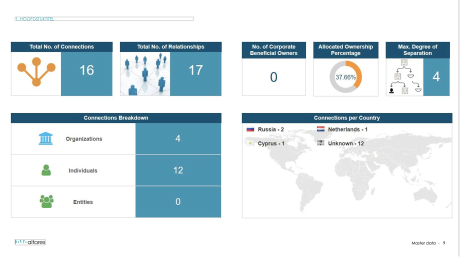
When your customer base is enriched with corporate structures and group relationships, the perspective changes immediately. It then becomes visible:
- Which customers are part of larger corporate structures
- How many entities are active within them
- Where there is overlap with your Ideal Customer Profile (ICP)
- Where concrete opportunities exist for cross-sell and upsell
What initially seemed like a single customer turns out to be a cluster of commercial opportunities.
Expansion within existing customer relationships is often more efficient than entirely new acquisition:
- Trust has already been established
- There are internal references
- The sales cycle is shorter
- Acquisition costs are lower
Provided you know where the opportunity lies
Interesting read: Everyone wants to do something with AI, but is your organization ready for it?
The power of data-driven customer expansion
Data-driven sales and customer expansion ensure that growth is driven by insight rather than chance.
The benefits:
- Higher conversion rates
- Shorter sales cycle
- Lower customer acquisition cost (CAC)
- Larger contract value
- Higher customer lifetime value (CLV)
By making market structures visible, expansion shifts from opportunistic to strategic.
New KPIs for a mature go-to-market strategy
Those who focus solely on new accounts do not see how deeply they are truly embedded in a market. A modern B2B go-to-market strategy therefore requires additional KPIs.
Think of:
- Revenue per corporate group or customer group
- Number of active entities per corporate family
- Expansion rate within existing customer groups
- Wallet share at the group level
- ICP penetration rate per corporate group
These metrics provide a more realistic view of commercial effectiveness and market position.
Interesting read: This is how you discover cross and upsell chances within your portfolio | Altares
Growth sometimes already lies within your own customer base
A mature GTM strategy is not only about entering markets, but also about deepening them. Not only about reach, but also about structure. Not only about new names, but also about existing networks.
The paradox is clear: many organizations look for growth far away, while part of it is already hidden within their own customer base.
Those who use better data insights to examine corporate structures, customer groups, and economic relationships discover that expansion is less often a hunt and more often a map you first need to learn how to read.